
HUPO Association

B/D HPP
Human Glycoproteomics Initiative

GET INVOLVED: Get in touch at office@hupo.org to learn more
Mission & Goals

The Human Glycoproteomics Initiative (HGI) was established in 2017 by Distinguished Prof Nicki Packer and Dr Morten Thaysen-Andersen (both Macquarie University, Sydney, Australia). The HGI evolved from the Human Glyco/Proteomics Initiative (HGPI) (2004-2016) headed by Prof N. Taniguchi and Dr H. Narimatsu. A/Prof Daniel Kolarich (Institute for Glycomics, Griffith University, Gold Coast, Australia) joined the HGI leadership team in 2021.

The HGI aims to increase the understanding of the functional significance of the extensive post-translational modification of proteins by glycans. This can only be achieved when the proteomics community has well integrated analytical and informatics tools available to more easily enable the determination of site-, protein-, cell- and tissue-specific glycoform structural heterogeneity in complex biological systems. While other -omics disciplines including genomics and proteomics have matured over past decades, glycoproteomics remains comparatively under-developed limiting our ability to gain insight into the immensely complex, dynamic and functional glycoproteome. Glycoproteomics may therefore be seen as one of the missing pieces of the -omics jigsaw puzzle.

Leadership Information

Chair:
Morten Thaysen-Andersen, PhD
Macquarie University, Sydney, Australia 

Co-Chair:
Daniel Kolarich, PhD
Griffith University, Gold Coast, Australia 

Co-Chair:
Nicolle H Packer, PhD
Macquarie University, Sydney, Australia 

Early Career Researchers:

Rebeca Kawahara, PhD
Macquarie University, Sydney, Australia
Tiago Oliveira, PhD
IMBA, Austrian Academy of Sciences, Vienna, Austria


HGI Aims

The HGI is a project/study-centric initiative; our modus operandi is to assemble relevant experts and field-leaders to complete specific studies of particular interest to the community. We seek to progress the field by influencing reporting guidelines (e.g. MIRAGE), nomenclature (SNFG) and experimental recommendations, and by connecting with and bridging into neighbouring disciplines. We aim to promote and draw more attention to our emerging discipline, highlight exciting opportunities and key challenges in the field, and unite like-minded scientists not least to bridge researchers in proteomics and glycomics through dialogue, comparative studies, and open sharing of data, tools and ideas.

The HGI also connects with other Biology/Disease-Human Proteome Project (B/D-HPP) activities in HUPO and permits the exchange of information of mutual interest. The data and information produced by the HGI will be shared widely with the community and will be made available for public, industry, academic research and teaching purposes.
Other HUPO INITIATIVES:

Industrial Advisory Board (IAB) Members

Scroll to Top

A goal of the 1st Human Glycoproteomics Initiative (HGI) Study was to assess the relative performance of current glycoproteomics software for intact N- and O-glycopeptide identification from high resolution MS/MS spectral data across laboratories. 

Profiling of intact glycopeptides at scale from complex biological mixtures (glycoproteomics) remains a considerable analytical challenge and a frontier in proteomics. It is recognised that the lack of efficient search engines tailored to the unique challenges associated with large-scale glycopeptide analysis continues to hinder the rapid expansion and democratisation of glycoproteomics technologies beyond specialist laboratories. Excitingly, the field has seen the development of many innovative bioinformatic tools over the past decade that promises to streamline and semi-automate the glycopeptide identification process based on high content tandem mass spectrometry data.

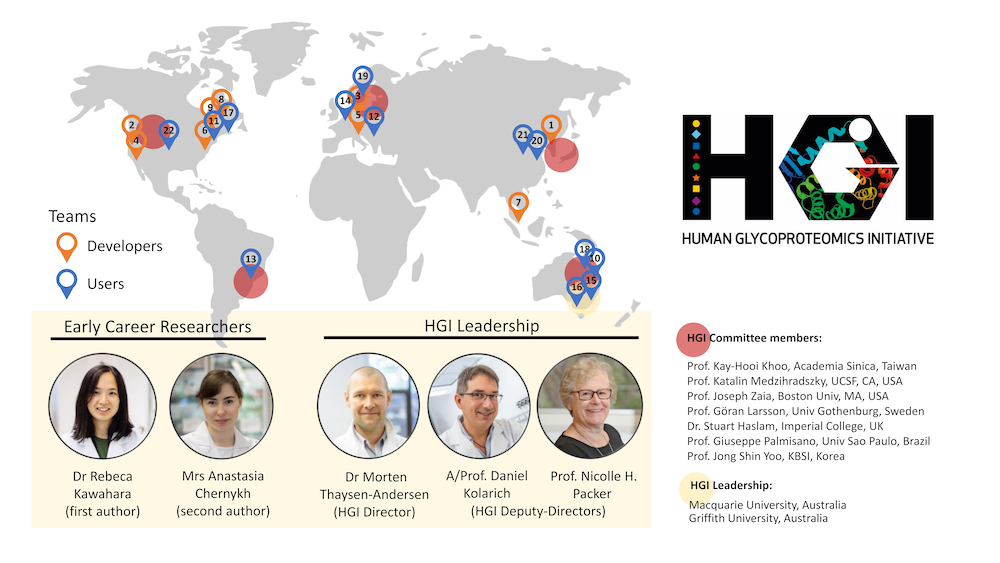
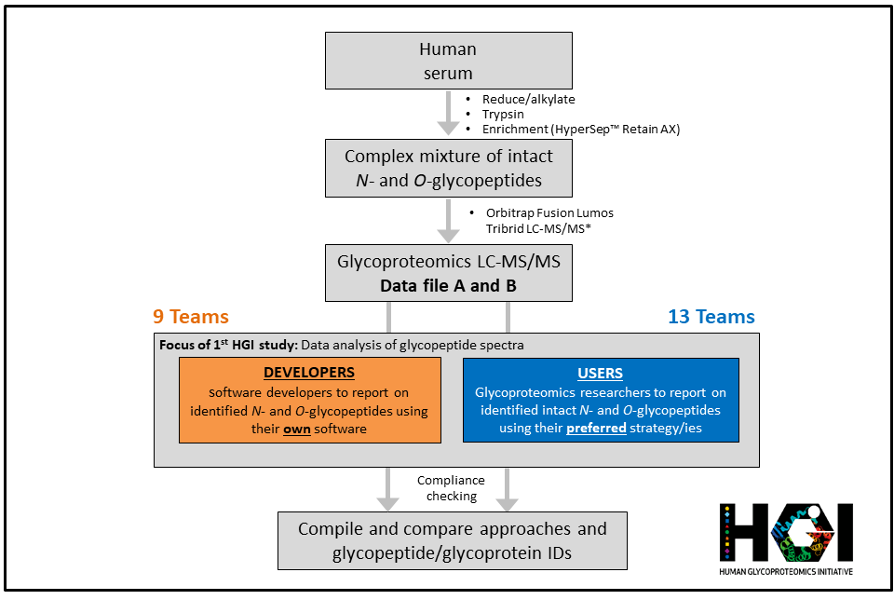
Conducted through the HUPO B/D-HPP – Human Glycoproteomics Initiative (HGI), this community-driven 1st HGI study brought together field-leading developers and expert users of glycoproteomics software to evaluate the performance of informatics solutions for system-wide glycopeptide mass spectrometric analysis [1]. In total, 25 teams from 11 countries across five continents signed up for the challenge out of which 22 teams (~90%) completed the study.

The study design including the sample type, preparation and data collection method was carefully chosen to mimic conditions typically encountered in glycoproteomics analysis while also aiming to accommodate most available informatic solutions and to appeal to users in the field. All teams were asked to identify intact N- and O-glycopeptides from two shared high-resolution LC-MS/MS data files (Data file A and B) of N- and O-glycopeptides from human serum proteins (LC-MS/MS data kindly provided by Drs Rosa Viner and Sergei Snovida, Thermo Fisher Scientific) and report back their identifications and their search strategies in a comprehensive and standardised reporting template. Completed reports were thoroughly checked by the study organisers for compliance to the study guidelines to enable a fair comparison between teams.

In short, we conclude from this study that diverse software for comprehensive glycopeptide data analysis exist, point to several high-performance search strategies, and specify key variables that may guide future software developments and assist informatics decision-making in glycoproteomics data analysis. While informatics challenges undoubtedly still exist in glycoproteomics, our study interestingly highlights that several computational tools, some already demonstrating high performance, others considerable potential, are available to the community.

Dr. Morten Thaysen-Andersen, Macquarie University, Australia (Chair)
Prof Nicki Packer, Macquarie University and Griffith University, Australia

A/Prof. Daniel Kolarich, Griffith University, Australia
Prof. Kay-Hooi Khoo, Academia Sinica, Taiwan
Prof. Katalin Medzihradszky, UCSF, USA
Prof. Joe Zaia, Boston University, USA
Prof. Goran Larson, Gothenburg, Sweden
Prof. Stuart Haslam, Imperial College, UK
Prof. Giuseppe Palmisano, University of Sao Paulo, Brazil
Prof. Jong Shin Yoo, Korea Basic Science Institute, Korea

Concluding at the end of 2021, the first Human Glycoproteomics Initiative community-driven study (Kawahara et al., Nature Methods, 2021) generated many insightful conclusions and, importantly, many interesting questions about data analysis throughout the glycoproteomics community. These open questions serve as the foundation for the second HGI-led community-driven study, which is now underway and in the recruitment phase for participants.

From the first publication:
“Thus, a limitation of this study is that newer tools are available at the time of publication that were not compared in our analysis. Follow-up studies comparing the performance of these latest glycoproteomics software upgrades and informatics solutions not included in this study are therefore warranted. Beyond testing the ability of participants to identify the peptide and glycan components of glycopeptides from glycoproteomics data, such future comparative studies should ideally also test the ability to accurately quantify (relative, absolute) and report on modification sites of identified glycopeptides and could explore other relevant parameters not addressed herein including the use of alternative proteases, tandem mass tag-labeling and stepped-HCD-MS/MS data among other experimental conditions gaining popularity in glycoproteomics.”

This second study will focus on teams of software developers only, with the goal to identify strengths and weaknesses of the very latest glycoproteomics software for glycopeptide identification and quantitation. Once all participant teams are set, sample types, data types, and reporting metrics will be decided with participant input.

Other Community Initiatives in the Glycosciences:

Job Posting Enquiry

Fill out the form below, and we will be in touch shortly.
Name